How I Got Into This
The IU seminar "Current Topics in AI" was the first time I seriously asked myself: how do you teach AI competence so that it sticks in practice and holds up against what pedagogy research tells us about how adults learn? I did not want to write a purely theoretical paper. I needed a practical field to test it in.
My first approach was education. I asked teachers whether they would be interested in an AI workshop. My inquiries to schools went unanswered. In online forums I was even attacked for suggesting it.
So I changed direction: adult education, specifically the public sector. That is where the leverage is highest. Municipal administrations handle many routine tasks that scale well with AI. At the same time, they have no budget for additional staff. Whoever knows how to use AI effectively saves working hours.
I contacted 10 municipalities in my area. 9 did not respond. The mayor of Empfingen, Ferdinand Truffner, agreed immediately.
Why ChatGPT Is Not Enough
Most people know AI from the news and have tried ChatGPT. But they hit its limits fast: the web wrapper is slower than manual work for many tasks and is impractical. The effort spent on post-processing is too high. The conclusion: AI is useless for me.
I think that is the wrong comparison. An LLM that generates code and builds tools that scale your own work is a different approach. In my own work I use Claude Code for exactly that. Teaching this difference in a workshop was my goal. The goal: solve concrete problems from the daily workflow.
The Empfingen Workshop
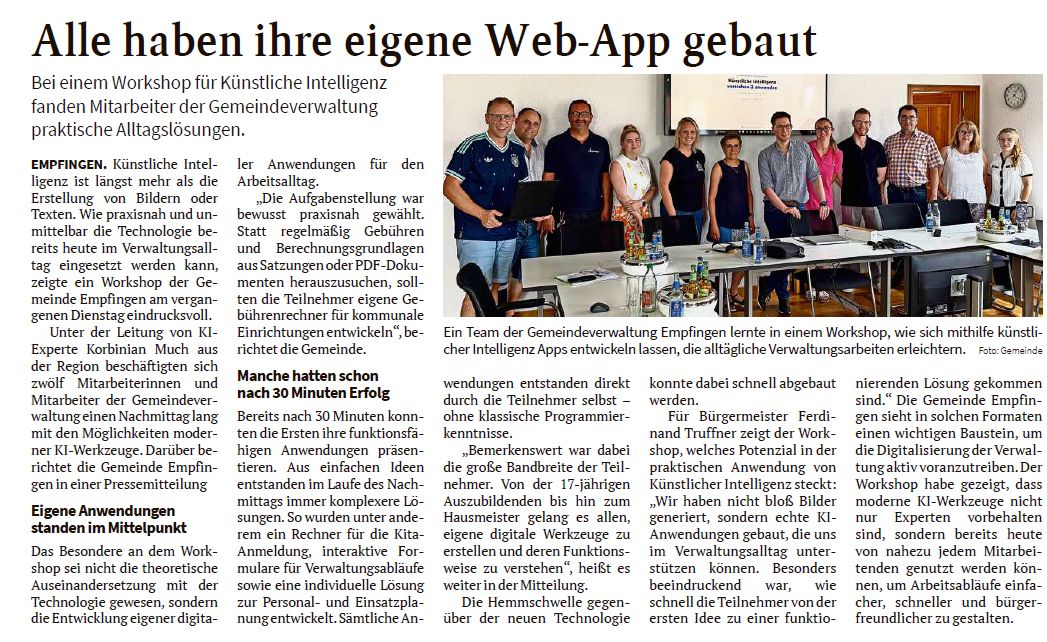
In June 2026, I ran an AI workshop at the town hall of Empfingen (Baden-Württemberg, population approx. 4,400, 10 staff members). Most participants had little technical background.
Mayor Truffner and I agreed: the workshop could only succeed if we worked on a concrete problem the administration already knew, and if the solution was accessible enough to implement immediately. Don't build bridges where there is no river. The pain point Truffner described to me: staff spend too much time calculating rental fees for municipal venues.
My proposal: participants learn how to build a web app that calculates these fees automatically. Local, no data leaks. The approach is accessible enough to show results immediately and transfers well to other problem areas.
Using an LLM as a code assistant, participants built a working HTML/JavaScript application within a single session. The tool reads the complete fee schedule, applies the correct rates, and calculates the total automatically. It runs locally and transmits no data.
What Research Says About This
Why did the workshop work? In my research essay I derive four conditions, supported by learning theories from Knowles, Mezirow, Kolb, and Bandura, and by the requirements Truffner set:
1. AI must solve concrete problems. Training begins with a problem analysis: which tasks are repetitive and currently done by hand? The context is part of the outcome. Practising on a fictional scenario produces nothing lasting.
2. AI is a tool that builds other tools. Using an LLM to summarise documents ties you to the provider and its data protection compliance. Building a local tool with it means you control the result. The perspective shift: "I can build something with AI."
3. Training needs a success experience. Every participant must leave with a working result. Those who experience that it works will believe they can do it again. The trainer does not deliver content. The trainer gets each participant across the finish line.
4. Data protection as a design principle. The legal framework is a design parameter. In Empfingen, only the publicly available fee schedule was entered into the LLM, no citizen data. Training that accounts for data protection from the start produces more realistic competence.
Conclusion
Knowing about AI and being able to use it are two different things. Closing that gap is a design problem, not an information problem. Or as Clausewitz put it: Knowledge must become ability.
Download the paper: Beyond Efficiency: Conditions for Sustainable AI Literacy Training in German Municipal Administration (PDF, Research Essay, IU International University, June 2026)